One-to-one learning
Your child and a clinician trained in naturalistic teaching, working on individual objectives inside play your child chooses: communication, imitation, social connection, and daily living skills.
For children ages 1 to 3. Our Early Intervention Program blends one-to-one naturalistic teaching with small-group learning through the group Early Start Denver Model, so your child builds communication, connection, and everyday routines, and grows ready for what comes next: school.
In the first years of life, the brain forms more than one million new neural connections every second. That is why early intervention matters, and why our program is built for young children, ages 1 to 3, whose families want a strong, joyful start.
Many families come to us right after an autism diagnosis. Others arrive with an early referral from a pediatrician or a nagging feeling that their toddler is not connecting the way other children do. Either way, you do not need to have everything figured out to begin. That is our job, alongside you.
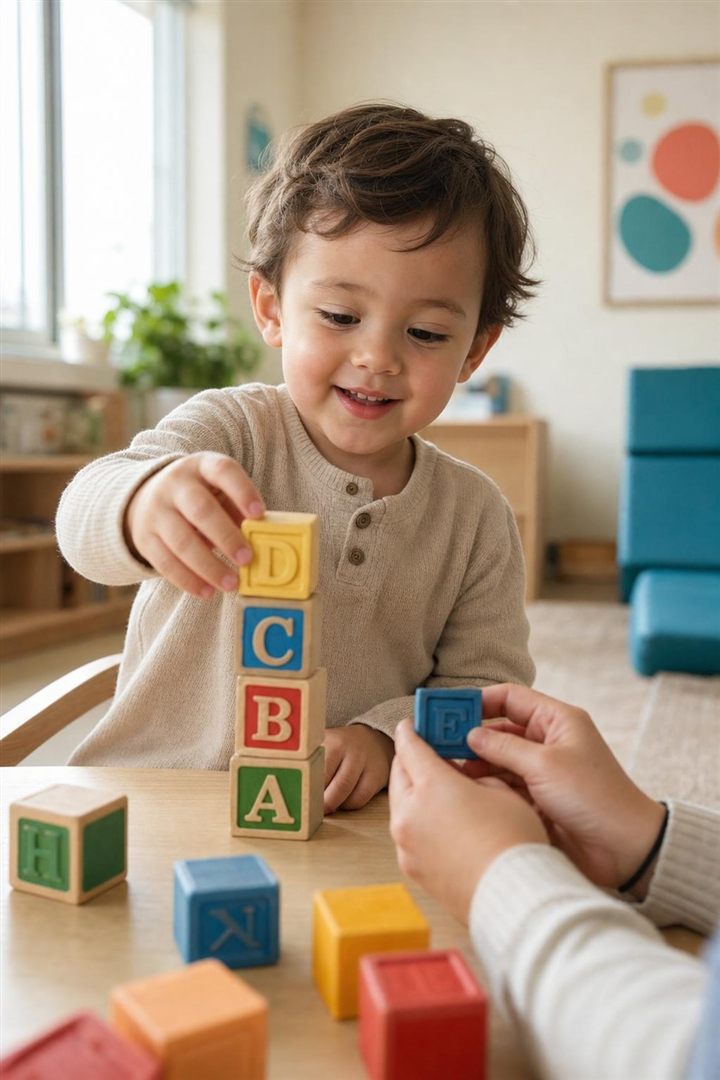
School happens in groups. So, in our program, does learning. Each day pairs individual teaching with shared activities where your child practices being part of a group, with support close by.
Your child and a clinician trained in naturalistic teaching, working on individual objectives inside play your child chooses: communication, imitation, social connection, and daily living skills.
Circle time, songs, snack, and shared projects, delivered through the group Early Start Denver Model. Children learn to join in, take turns, and participate in group instruction, the way a classroom will ask them to.
Arrival, transitions, handwashing, cleanup, and goodbyes. The small routines of a school day are taught on purpose, so they become familiar long before the first day of school.
Led by a behavior analyst who is ESDM certified and trained in the ESDM parent coaching program. You learn the same strategies we use, so social and language growth continues at home, at the park, and at bedtime.

The Early Start Denver Model is one of the most rigorously studied early interventions in autism care, and it was designed to be delivered by warm adults inside everyday play. The group version keeps everything that makes ESDM work, then adds the ingredient a classroom will demand: other children.
In a group, peers become models and motivation. Your child practices waiting, watching, joining, and responding in a setting that looks and feels like preschool, with a clinician there to make the hard moments smaller and more supported, never colder.
Our program is led by a certified ESDM therapist, and every objective is measured in every session, so the plan follows the data and the data follows your child.
Deep Dive: Our Naturalistic ApproachThe ESDM Curriculum Checklist maps your child's skills across communication, social interaction, imitation, play, cognition, motor, and self-care.
Every 12 weeks we write specific, measurable goals with you, in language you understand, that matter in your child's real life.
Objectives are woven into one-to-one play and group activities, and data is collected in every session so the plan adjusts as your child grows.
As school approaches, our Transition Program plans the handoff: school-readiness skills, IFSP and IEP support, and coordination with your child's new team.
Children ages 1 to 3. Our Transition Program serves ages 3 to 6, and our Social Skills Groups serve ages 6 to 12. Our team can help you find the right fit for your child's needs.
There's no universal right number. Intensity is individualized based on your child's assessment, your family's life, and what the research supports for their goals. We'll recommend a schedule and explain our reasoning during intake.
Insurance coverage for ABA-based services typically requires an autism diagnosis. If your child hasn't been evaluated yet, reach out anyway. We can point you toward evaluation options in the St. Louis area and help you understand what comes next while you wait.
Very. Caregiver coaching is part of the program, not an add-on. You'll help choose goals, learn the strategies through the ESDM parent coaching program, and review progress data with us every cycle.
We plan for it from the start. Group learning and daily routines are built into the program so school feels familiar, and our Transition Program supports your family through IFSP and IEP planning and the move into a school setting.