The child leads
Sessions are built from activities your child already loves. Motivation isn't manufactured with rewards; it comes from the play itself.
Naturalistic developmental behavioral intervention, NDBI for short, is what happens when developmental science and applied behavior analysis stop competing and start collaborating. This page is the full story: what it is, what a session actually looks like, how we measure progress, and the research behind it all.
NDBIs are a family of early-intervention approaches for young children. The best known, and the one our clinical program is certified in, is the Early Start Denver Model (ESDM), developed by psychologists Dr. Sally Rogers and Dr. Geraldine Dawson for children roughly ages 1 to 6, when the brain's capacity to learn from relationships is at its peak.
It weaves together two traditions. From developmental science, NDBIs take their understanding of how all young children learn: through relationships, imitation, shared attention, and play they care about. From applied behavior analysis, they take precision: clear teaching objectives, careful measurement, and decades of research on how skills are built step by step.
The whole family of models shares one promise, and it is the promise our clinic is built on: therapy that looks like play and works like science.

Sessions are built from activities your child already loves. Motivation isn't manufactured with rewards; it comes from the play itself.
Warm, responsive interaction is the delivery mechanism. Shared smiles, turn-taking, and back-and-forth games carry every learning objective.
Every objective is measured in every session. If a strategy isn't producing progress within a set window, the plan changes, not the expectations of your child.
NDBIs were designed from the start to be shared with caregivers, so the strategies live in your home and routines, not just in our clinic.
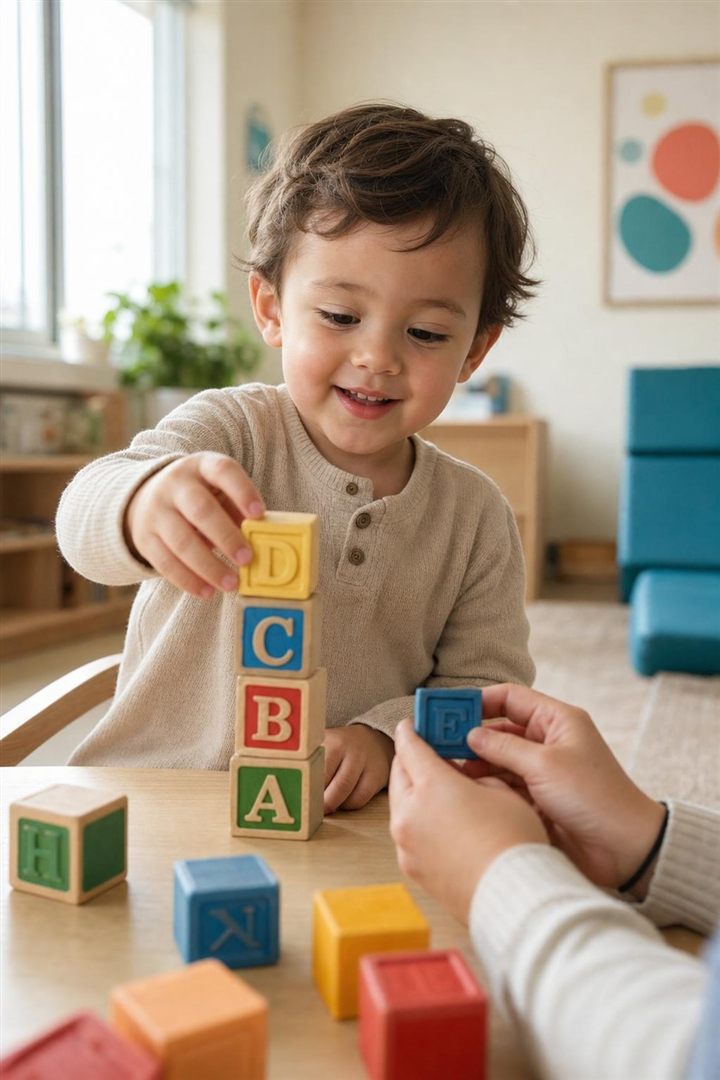
Core sessions at our St. Louis Metro Area clinic are one-to-one: your child and a clinician trained in naturalistic teaching. Parents have an open invitation to observe sessions. Sit in and you'll see blocks, bubbles, songs, and snack time. Look closely and you'll see something more choreographed. And one-to-one is only the beginning: our social skills groups put growing skills to work with peers.
The connection skills your child grows in one-to-one sessions don't stay in the therapy room. Our social skills groups give them a real place to land: peers, play, and belonging.
A supported pairing: your child practices connection alongside one peer, with a clinician nearby. The gentlest first step from 1:1 into social play.
Small-group fun with a purpose: games, projects, and shared adventures that turn social learning into something kids ask to come back for.
Ongoing groups focused on the real ingredients of friendship: sharing, listening, taking turns, and celebrating each other.
Our flagship model, ESDM, comes with its own assessment: the ESDM Curriculum Checklist, which maps your child's skills across developmental domains and turns them into concrete, individualized objectives.
When behavior gets in the way of learning, we start from a neuroaffirming question: what is this behavior communicating? A child who drops to the floor during transitions isn't giving us a problem to eliminate; they're telling us a transition is too hard, too sudden, or too unclear. The plan that follows builds skills and supports, like predictable routines and better ways to say "not yet," so the hard moment stops being necessary.
Among NDBIs, we lead with the Early Start Denver Model because the research earned it, and our program is led by a certified ESDM therapist. These findings come from published, peer-reviewed studies of the model.
In the landmark randomized controlled trial, toddlers receiving two years of ESDM gained an average of 17.6 IQ points, versus 7.0 with standard community care, with gains in language and adaptive behavior too.
Dawson et al., 2010, PediatricsA meta-analysis spanning 12 studies and 640 children found significant benefits for children receiving ESDM, strongest in cognition and language.
Fuller et al., 2020ESDM was the first comprehensive early-intervention model for toddlers with autism validated in a randomized controlled trial.
CEBC program reviewResearch findings describe outcomes across study groups; every child is different, and we design treatment and measure progress individually.
Some families worry that a structured model means a rigid one, or that data-driven therapy means a child molded to a chart. Here is where we stand:

Naturalistic developmental behavioral intervention: a family of early-intervention approaches that teach through play, everyday routines, and relationships rather than table drills. The Early Start Denver Model is the most-researched NDBI and the one our clinical program is certified in.
Yes. ESDM applies the teaching principles of applied behavior analysis inside naturalistic, play-based, relationship-centered routines. It's ABA delivered the way developmental science says young children learn best. Insurance plans that cover ABA typically cover ESDM-based treatment.
The Early Start Denver Model was built for children roughly 1 to 6 years old. At Developing Minds, our Early Intervention Program serves ages 1 to 3, our Transition Program serves ages 3 to 6, and our Social Skills Groups serve ages 6 to 12. Our team can help you find the right fit for your child's needs.
There's no universal right number; intensity is individualized based on your child's assessment, your family's life, and what the research supports for their goals. We'll recommend a plan and explain our reasoning during intake.
That's not the goal, and we'd encourage caution with any provider who promises it. Naturalistic therapy helps your child build communication, connection, and independence skills that make their life bigger. They will still be wonderfully, permanently themselves.
Central. You'll help choose goals, learn the strategies through caregiver coaching, and review progress data with us every cycle. Research on ESDM includes parent-delivered versions for good reason: you are your child's most important teacher.